Friday, 5 February 2016

Research: Film Openings- 9 frames Title sequence analysis


Title sequence analysis.
Zodiac (David Fincher, 2007)


The order.

1- (00:10)The production companies
'paramount pictures
and warner bros. pictures present'

2- (00:20) Distributors
'a phoenix pictures production'

3-(00:26)Director
'a david fincher film'

4- (00:30)Main actors

5- (00:50) film title
'zodiac'

6-(00:58) supporting actors

7-(01:07) supporting actors

8-(01:19) supporting actors

9-(01:25) supporting actors

10-(01:34)
'Casting by'

11-(01:40)
'costume designed by'

12-(01:43)
'sound designer'

13-(01:47)
'original score'

14-(01:52)
'music supervisors'

15-(02:04)
'edited by'

16-(02:11)
'production designer'

17-(02:15)
'director of photography'

18-(02:23)
'based on the book by'

19-(02:28)
'executive producer'

20-(02:32)
'produced by (list of 3)'

21-(02:38)
'produced by (list of 2)'

22-(02:49)
'screenplay by'

23-(02:58)
'directed by'


Analysis.

The 'zodiac' opening sequence establishes a sense of mystery with the credits turning into a blend of symbols-seemingly out of place with the slightly warm glow of the shots as the ordinary morning routine of a father and son is portrayed.
The film is based on a true-story of the notorious serial killer known as 'The Zodiac Killer', through this the yellowish effect can be seen as a sepia, vintage style effect, connoting the idea of passed time.

From the very first second of the film we are asking questions. '4 weeks later- San Francisco CA' appears on screen, but 4 weeks after what?. The location also must have more meaningful significance since it's not usual for an establishing shot to show the location

Film opening - 9 frames title sequence analysis


The Interview, 2014


My timeline

For this task we were asked to watch a thriller opening, i chose 'The Interview' 2014. After we watched the opening we had to make 2 timelines of the text and sound. We then had to note down any text that came up, for example the producers and cast names. Then note down any sound so i wrote down instruments i heard and how long they lasted for. The opening lasted for  01:14 minutes and there were 20 different types of texts, while sound had only had 11.

Thursday, 4 February 2016

Logo Research- Aleks


Film Production Company Logos Research.

Based on these major production logos the pivotal element to a logo seems to be the animation. All of these logos including the independent Pathe and Studio Canal, have some sort of movement; it wouldn't be the same if the searchlights in Fox Searchlight pictures were still or the lion in Metro Goldwyn Mayer didn't roar.- Which brings me onto the second element: sound,playing a lesser yet still important role it's as if the visuals and sound of the production logos are an establishment of these two senses prior to the films beginning, a preparation.


preliminary evaluation


As this was our first time filming and editing it is clear that improvement is needed, but we did include the three main objectives which were the 180° rule, match on action and SRS (shot reverse shot).

The 180° rule -

The 180° rule is a rule which two characters should have the same left and right relationship to each other. this rule is very important in video and film production. When a camera crosses the 'axis' connecting to two subjects it is called 'crossing the line' and the new shot is called the reverse angle but crossing the line is usually something that should be avoided. 

Match on action -

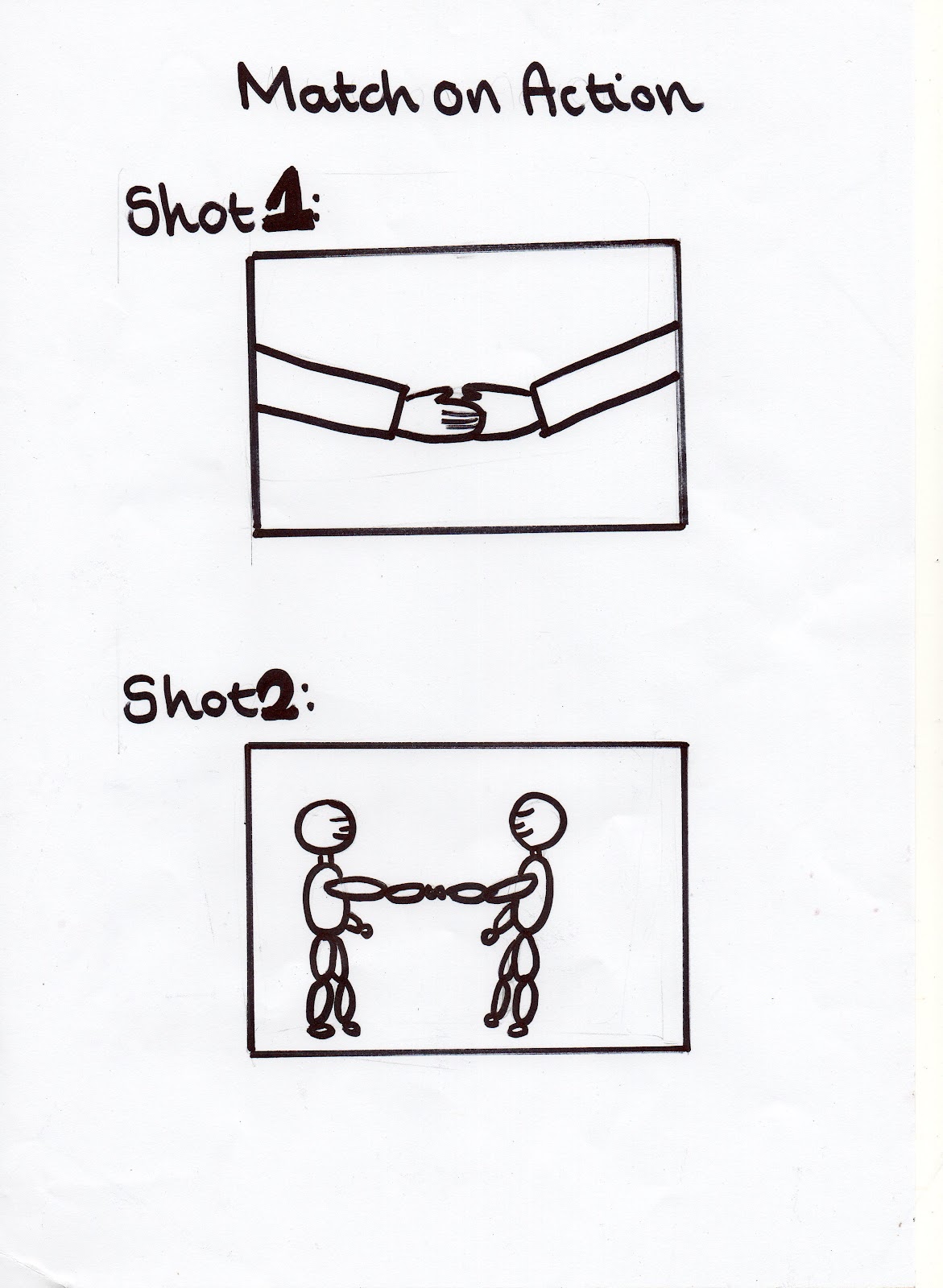
Match on action is the cut between two shots that show no time has passed between them. It is when you cut during an action to another camera angle but showing the action from the same point in time that you left it from the previous shot. it is important to have a continuous flow of a scene.

The clip below which we edited shows match on actions. it could be improved, for example zooming into the hand on the door to clearly show that match on action was used but as this was our first attempt we know how to improve it for next time.


Shot reverse shot (SRS) -

Shot reverse shot is a continuity editing technique which is mainly used in conversations or characters looking at each other or objects. A shot showing a character supposedly looking at someone or an objects is usually followed by a reverse angle shot of the character looking at it, or of the character looking back at them. Shot reverse shot ties in with the 180° rule to retain the continuity by not distorting the audiences sense of location of the characters in the shot.

The clip below shows match on action, due to it being our first attempt it needs slight improvement.


During the pre-production stage of our short film we had to come up with quick ideas as we had limited time. First of all we decided who was doing what part, I decided that  i would play one character and Anelka played the other. Eoin and Aleksandra both worked together to film making sure angles were right. We worked well as a team coming up with the idea of what we would film in the short amount of space we had. We then decided on the location, genre and narrative of the short film. we came to a quick and easy agreement by putting forward each of our ideas and putting them together. As our short film was based on someone buying drugs of another person it was pretty easy when deciding on the location, and as we had to remain on school premises due to the short time we had we chose to film on the stairs which was fairly easy. We kept the dialogue fairly straight forward and simple which fitted in with the limited time we had. We didn't have much planning time so we didn't have enough time to make a story board to make a quick sketch of what we would do, this would of helped our group have a better and clear understanding of what we would be doing before we started filming.


                            Example of a story board.


During the production filming the short film we worked very well as team to use our time wisely but to also include the three main principles which were match on action, 180° rule and short reverse shot which I think we did well but improvements could be made next time but as it was our first time for all of us using the DLSR camera. We all knew our parts and what we needed to do so there was no time wasted or confusion. we set up the DLSR camera up and played around at filming a few shots first before we filmed the shots we needed to then edit later. A few problems came up but none which were a major problem. There was some ambient sound from other pupils and teachers walking around near to where we were filming so we filmed a few shots more than once to make sure the noise was not heard.
 
In the last process of post production we had to edit the shots taken to make the short film flow. we used a editing program called 'Final Cut Pro X' which was all of our first times using. we took apart raw footage which was needed and split into two groups of two and created separate short films which allowed us to all have a turn at using the program. Within the editing myself and Aleksandra who I worked with learnt how to add in sounds, transitions and how to enhance certain shots which will help us a lot when editing the real Thriller opening. We all started of with the same raw footage but the end result of the short film would be different by using different editing skills.
 
This preliminary task helped not only me but also my group a lot and gave us a better understanding of how to use the DLSR camera and editing program 'Final Cut Pro X' which will help us when creating a thriller opening. As a whole I think our attempt at using working as a team, filming, editing and using the three main principles went well but areas need to be improved which we are aware of that will not occur in our thriller opening.


Prelim Evaluation

With our first encounter with editing behind us there is pretty significant room for improvement...


Overall we did complete the three assessment objectives...


-180 rule;
The 180 rule is used in order to not confuse the film viewer. By passing the '180 degree line' the characters you are filming would swap positions -like in a mirror image.
The rule can however be broken on purpose in order to create a feeling of unease but this should only be done fittingly according to theme and by experienced camera operators.

-SRS
Shot reverse shot is used to show dialogue taking place where one person is talking to another. The camera shows person X from the right shoulder of person Y, normally including a fragment of their hair or clothing in the shot if not their full head. (And vice versa)


When it comes to our genuine opening more thought will obviously be put in at the pre-production phase, including overall story -line, character development, location, costume makeup etc.

Story-boarding will be an essential part of our thriller opening to establish a clear order and decide on camera angles, movement and shots and lighting as well as take in mind necessary props.


Story board by Dulani Wilson for The Blunts.

While we did not create a storyboard for our Preliminary task ,and rather just improvised, I have attached above an example of one, which effectively displays the shot as well as the name of the shot and the action taking place- a stage direction if you will.

In the above story board, though the action is mild and scene short, we see a good variety of shots. This contrasts with our Prelim where there was solely the tracking shot, mid shot and over the shoulder (/shot reverse) shot, the lack of variance results in footage that lacks depth and quality. If given more time to shoot we could've included a close up of the 'girls' face or a close up of her hand as she pushes the door open.


Lighting was another problem encountered; Strong sunlight directly entered through the window however Melissa and I tried to use it to our advantage in masking a poor cut through a light leak transition on 'final cut pro'.


EDITING
First of all we must work on the use of sound in our film as well as cutting to create better continuity; as clear slack was visible here in the dialogue exchange in the shot reverse shot, due to the dialogue being very short it further emphasised the jumpy quality.
Furthermore our production logos were put in after joining footage so it was difficult for us as newbies to final cut pro, to edit in the title and production logos infront of it, thus having to squeeze it into a tight space there was a limited amount of time for these to appear. There was only a few seconds for the title to appear which looked very amateurish. Moreover the title appeared before the production and distribution logos which would not happen in a real film.
-Production logos on screen for too short
-appeared after the title


Tuesday, 2 February 2016

Preliminary |Evaluation

In film making, the 180-degree rule is a basic guideline regarding the on-screen spatial relationship between a character and another character or object within a scene.

When filming we wanted to make sure we had this rule correct, as if we got this wrong our preliminary video would not if been a success. This rule is relatively easy to follow so we didn't have problems when filming and editing.

using final cut pro fir the first time was a fun but challenging experience, I have never used any editing software before so I thought it was going to be a nightmare, and for sending parts it was for example sound and sound effects was very challenging when it came to using this software. when explained how to use certain features it was easier to use and relatively easy too remember.

Adding Credits and title cards was easy to add to our preliminary.
if I was to change anything on my preliminary, I would add more content to it, to achieve thatIi would of filmed more and possibly added some library footage to create a different aspect to our preliminary. also more planning to get.a definite genre because when planning the was supposed to be mystery/drama feel but when editing it had changed to a comedy. 


Shot reverse shot (or shot/countershot) is a film technique where one character is shown looking at another character (often off-screen), and then the other character is shown looking back at the first character.

When editing our shot reverse shot to run smoothly as one sequence it was tricky as me and Eoin could not find how to order it in proper was using final cut pro, it's hard to do this sequence because due to the speed of the dialogue also Melissa and Myself conversation seemed quite fast so cutting between shit where milliseconds, using the mouse seemed hard to control how much you cut also.


Match on action (or cutting on action) is an editing technique for continuity editing in which one shot cuts to another shot portraying the action of the subject in the first shot.

I found this the most challenging we took the first, two shots but missed out the third making it a challenging sequence to achieve.

Monday, 1 February 2016

Eoin's Preliminary Task Evaluation

Overall Evaluation!
Our preliminary task turned out well and a lot better than expected!

Neither myself or anyone else from my group has had any past experience with any filming or editing any sort of short film or any project similar to this. Despite this, the end product was still very impressive, given the short amount of time and the lack of knowledge known.

This task was a great learning curve and helped me to learn some basic editing skills which will help me in the future. One huge thing which I learnt from from this task was the fact that you need to be prepared to record a lot more clips than you'll need, in order to make sure at least one of them is perfect.


One thing that we did not do was create a story board for our preliminary task, so here is one that I found online as an example of a simple storyboard. However, I felt that because the video we shot was only short, this was not needed. When it comes to creating our actual thriller film opening, I know that multiple story boards will be needed.

Overall i think that the preliminary task was very successful and has taught me a lot as to what I need to know for the real filming and editing of the thriller film opening.

What is the 180 degree rule and did we include it?
The 180 degree rule by Levi Wigglesworth is a basic rule that means that two characters should always have the same left and right relationship with each other. When a camera crosses the acid connecting to two subjects it is called 'crossing the line'. The new shot is called the reverse angle. The 180 degree rule was a key part of the preliminary task and we made sure to include it and made sure not to break it.
What is match on action and did we include it?
To use this technique in editing cut from one sot to another view that matches the action and pace of the first shot. This creates an impression of continuity despite the fact that you might have filmed the shots weeks apart. If a character begins an action in the first shot and completes it in the next, a visual 'bridge' is created that acts to disguise the cut from one to the other. We made sure to include this rule and I feel that we did this extremely effectively.

What is shot-reverse shot and did we include it?
This effect is so common it is impossible to imagine film or TV without it. Nevertheless, it takes some practice to master. When two characters are in conversation, film one character looking off screen to where the other character is imagined to be, and vice veers a. Ensure that one character faces left and the other faces right, so you can edit between a character talking and a character listening. We included this in our preliminary evaluation very effectively.